Saturday, August 2, 2014

Living in a Renaissance Palazzo in Italy: Viterbo


Palazzo Chigi's tower
In central Italy  it is not  so unusual to live  surrounded by affreschi  of Renaissance masters.  The other day we were invited to visit  Serena Filoscia and her uncle Luciano who live in one of Viterbo’s most imposing buildings: Palazzo Chigi.
stairway to piano nobile

 Located in the very center of Viterbo, adjacent to City Hall
 (Palazzo dei Priori), over the ages the austere building has been home to numerous  powerful local families:  Caetani, Chigi , Montoro, Patrizi and  Crescenti.

For the past  few generations   the Egidi family  have called  it home and have done major  restorations, including that of the palazzo’s  tiny  private chapel.

loggia of Palazzo Chigi 

“The roof is so huge that it seems we are always repairing  it”, confided Serena as she greeted us at the front entrance doorway.   She and various other family members   live in apartments located  on the  main floor,  il piano nobile, where the ceilings  rise up  to an enormous height.  

Entering the  portone one catches a glimpse of  a beautiful fresco  by  Antonio del Massaro   (known as Pastura)  hidden behind a car and a dusty  Vespa.
Madonna attributed to Pastura 

 On the upper levels  frescoes greet  visitors at every turn: at the  top of the steep staircase, on the  loggia and throughout the reception rooms.

The windows  of the main salone  face an  imposing stone fireplace and give sunlight to the   numerous plants.  To one side, an  early piano-like instrument  ( un clavicembalo)   awaits  restoration.  

Renaissance  fireplace 
Uncle Luciano leads us into a smaller living room with  silk covered walls and family portraits. In one corner a 1980s  music center  and a piano  show that this was the room the family used for parties. 


A curtain is pulled up with a cord to reveal another room, the family chapel. Luciano shows us the chest of drawers in a niche that serves as sacristry.


 It must have been constructed on site, since it is  too large to have gone through the doorway.


sacristry of the  chapel 


The frescoes of Palazzo Chigi  have been the object of a university  thesis  and I understand why when we are shown a further, smaller  room completely  covered  with frescoes of gods, landscapes and hunting scenes  by Antonio Tempesta. 


At eye level there is a  parrot which gave  the room its name, Stanza del Pappagallo.


How does  this  Renaissance scenario and lifestyle  fit  in with today’s  world ?

 Just a short  walk from the historic  palazzo,  in Piazza S. Maria Nuova, you can visit the shop  GustoSi Senza Glutine where   Serena’s companion  has just opened  the area’s first laboratory  preparing  gluten free bread, pasta, pizza and sweets.  It is located  across  from the  outdoor  pulpit where St. Thomas Aquinas used to preach to the crowds in  the open air, many centuries ago. 

You will find many more stories of life in the Tuscia/Etruria  area in  my books which can be ordered directly from the website. 
Feel free to leave a comment  below and share with your friends  by clicking on the  icons.  
You can sign up to receive  new stories by leaving your email at the very bottom of this page.  


Saturday, July 26, 2014

Living in a Castle in Italy: Proceno


Castello di Proceno  from the town hall
When  the sun burns down and the humidity levels rise,  the  naturally cool, dark interiors of a medieval castle offer  a welcome solace; thus July is  the perfect time to  visit friends who own castles and historic homes here in central Italy.


town hall entrance 

Last week after a stop to see the Archives in Acquapendente (more in a future post), we drove further along the Via Cassia  connecting  Rome to Siena and Florence to the  hilltop town of  Proceno which straddles  the border separating  Lazio  and the former Papal States from  Tuscany.


Nearby is the old  customs house  of Centeno (cento=100  miles from Rome ) where travelers including Galileo (in 1648) and  Nathaniel Hawthorne  (in 1845) underwent quarantine  and  had their bags  searched for anti-Papal literature.


At the hour of our arrival, Proceno was deserted except for  a butcher’s cat but the town hall -Palazzo Sforza - was open to the breezes and offered sweeping views over the  town’s cotto tile rooftops, the Paglia river  valley below  and the neighboring hilltowns of   Radicofani  (in Tuscany)  and Torre Alfina, famous  for  artiginal  gelato.  
the  formidable Town Hall,  Palazzo Sforza 

There was a distinct difference of temperature inside the Castello  thanks to the brick floors and thick walls. 

 We were welcomed by owners Giovanni and Cecilia Cecchini Bisoni,  and their two dogs. 

with Cecilia and Giovanni

the castle dogs are named after Roman gods


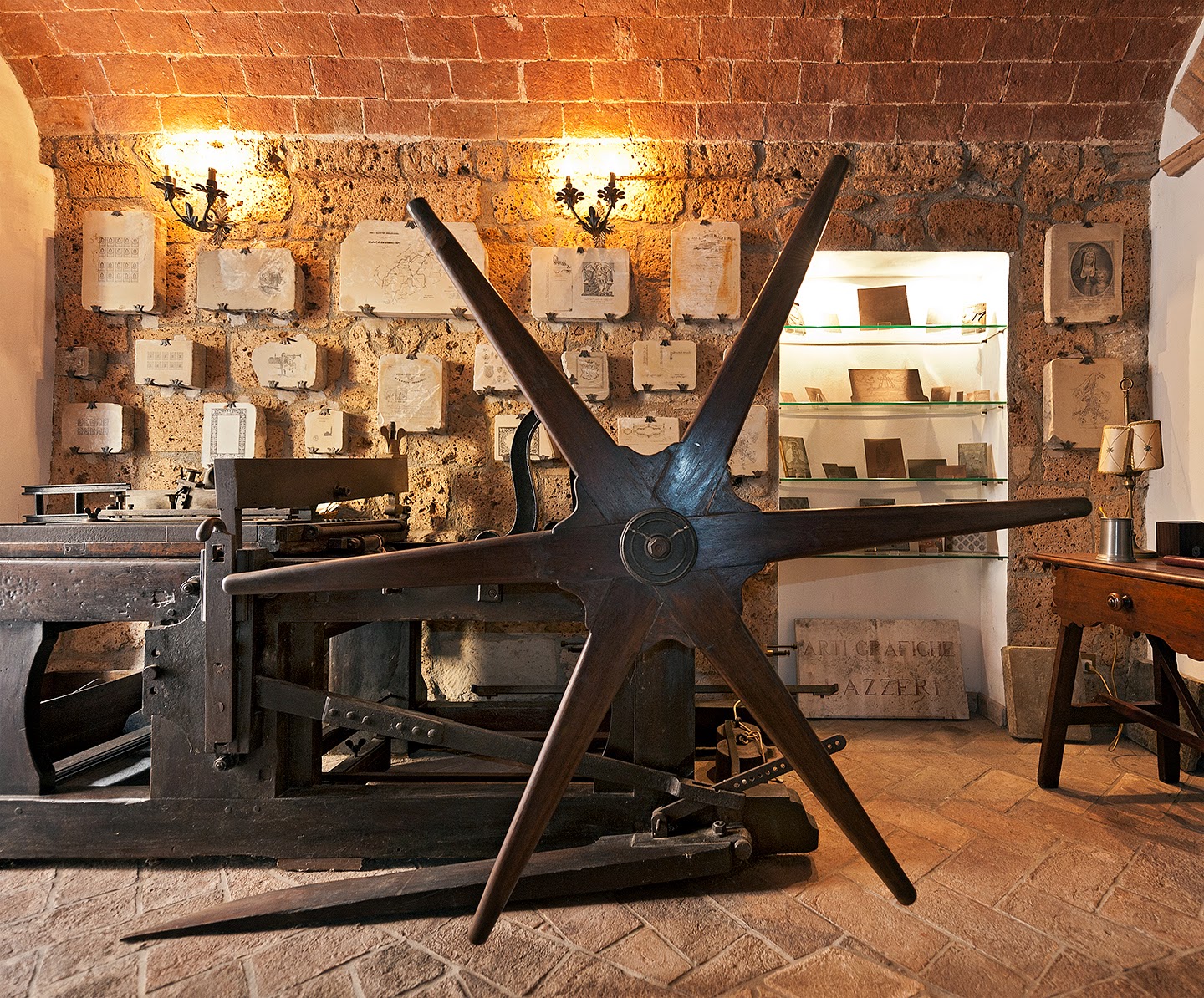
The entrance hall houses  an  antique  printing press  (torchio)  and many other interesting implements once  used in the Cecchini family’s printing business in Siena. 


Giovanni and Cecilia  open their castle to visitors who  stay in  comfortable self catered apartments,  take cooking classes and enjoy the area’s fine wines at the  castle’s Enoteca. 

The castle is also a resort,  for in the lower gardens  guests may  enjoy the  marvelous swimming pool and  restaurant serving top level cuisine and wines. 
cooking in the castle kitchen

Spring and summer bring visitors from around the world  who come to  enjoy the pleasures of living in a castle  plus  local people who come to enjoy the  well known  concert series. 

You can find out more about the area of Proceno, Onano and Centeno and it's remarkable Irish connections in my books about the area, which are available also at the Castello di Proceno. 

These wonderful places in central Italy are too special to keep secret, so share  your knowledge with friends  using the  Facebook and Twitter icons below. 
 Please leave a comment  below and let me know if you would like to join me in visiting other historic homes, castles and palazzi in central Italy. 
Other castles  we visit often are : this one in Mugnano, near Bomarzo and that of Vignanello.  

Sunday, July 13, 2014

Italy's Antique Doors


Old Italian  doors  are often featured  on  calendars and  postcards  for they are  icons of “picturesque Italy”.


There is more than meets the eye, for original, antique doors, many dating back 300 to  500 years,  give us a glimpse into the past, a look at the lifestyle  and hint at what was important to  people  in days gone by. 
Sant'Egidio chapel

The  linguist will find a whole new set of words used for describing doors, doorways, locks and  keys .

flowered plant overwhelms this tiny doorway 


 The  story of an old palazzo   in my latest book  tells how  the  crumbling wooden  entrance way leading down into the cantina  where local farmers once stored their products (oil, hazelnuts,etc.)  had to be replaced in order to become a dignified entrance way. 

how my door used to look
The new door was created by one of the local  carpenters following our own design. It made  a statement, telling all who passed by that the once abandoned building now had  a new owner, one who had  undertaken a huge, costly  restoration project.  


Since then many others (mostly foreign born),  have followed suit,  buying up and restoring  other  historic  properties and bringing  new life to the town.
new door created by Santucci falegnameria, Vetralla 

Walk along the street  and you will see all types of doors from ugly metal ones  added in recent years to this gem recently restored to its original glory  by falegname Pino after  several generations of neglect.
Pino restored this 16th century door 


Note the nailheads  and the tiny door/window  which allowed light in to the dark entrance stairway.  The building dates from  1581 and Pino guesses that the wooden doorway also  dates from about that time.


 Cantina level doorways can be small and derelict . Most have a sliding bar and system of closure with a giant iron key and lock. 

The holes allow for  air circulation for   the wine.   


cantina entrance near  Madonna del Riscatto church


 Instead of doorbells, gorgeously detailed  bronze batocchi decorate most  doors in Italian towns. 
Palazzo Vinci  1595


Baroque  doorway 


 Besides the practical use of resounding a hearty knock , batocchi  reflected  contemporary  fashion  and family status.

 The sphinx-like heads from this door in Viterbo’s center dates around  the Napoleonic  invasion of Egypt, 1798-1801.

flowered doorway for a neighborhood chat

Thursday, July 3, 2014

Rome's Best Cappuccino and Cooking School

As you know I have lived in Italy for 50 years and authored many   guidebooks about the Eternal City but  last week  I made a discovery that proves  the old adage is ever so true......"  ROMA-non basta una vita " -Rome - a lifetime is not enough". 


"Caffe Greco" oil painting by Valerio Cugia 


Yes, after all these years I finally discovered  Rome's  very best cappuccino! And to think I lived   close by for 7 years but was unaware of the  existence of this tiny caffe that serves coffee, only coffee, and makes the absolutely best cappuccino in the city. 

Forget about Tazza d'Oro and San Eustachio, the   haughty  barmen and overpriced  table service.  
price list at Sciascia  (click to enlarge and read) 

Back in the 70s there was no internet, Facebook or  apps that  spread the word or made comparisons about value for money. Every Roman street corner   had a bar or  cafe and residents did not explore  the  city searching for  the perfect caffe , rather when they  felt a longing for a mid morning caffe, they just popped in to the closest  bar. 

It seems that Roman  lawyers and judges  were in the know all along, but weren't  telling anyone,   for more  than 2,000 satisfied customers, mostly   lawyers working at the nearby legal offices and courts,  make their daily  coffee break at the  historic  Sciascia Caffe 1919  in the Prati neighborhood.


It is a Roman institution, but because it is  not in the touristy center of Rome, nor does it serve food or have sidewalk tables,  it is rarely mentioned  on  lists of  “musts”  for  visitors
One could pass by without noticing  the  entrance at  Via Fabio Massimo 80a.


Only  the sign in the  window  declaring it  a negozio storico (historic shop)  gives away  its status.

The  refined interior  still has some of the original  velvet chairs and a vintage leather sofa, wooden ceilings and  tiny tables  that make  a statement of elegance from  bygone days. 

 Rome’s best cappuccino  is served in  delicate Richard Ginori porcelain  cups with silver spoons.


with Valeria  at Cuochepercaso 
It is located on Via Fabio Massimo, 80a, inbetween  the metro stops of  Lepanto and Ottaviano, a short walk from the Vatican Museums and directly across the street from the cooking school Cuochepercaso  where we were invited to present Fulvio's cookbook "Olio e Ricordi in Cucina"  last week. 

The barista at Sciascia1919  is friendly and proud of his coffee making skills. He is backed up by Giulia who speaks  some English. There is no service charge,  you order and  pick up  your drink from the bancone and then if there is space,  relax at one of the tiny tables.  There is free wifi and a clean  toliette. 

Sciascia is open from 7:30 a.m. to 6:30 p.m. because that is when the clientele  is in the area and because the law offices and courts take holidays in August, they are also closed most of that month.

Friday, June 27, 2014

Lavender Fields near Rome,Viterbo and Civitavecchia


Wide expanses of purple flowers, a heady perfume, bees buzzing…no, we are not in Provence, nor in faraway Tasmania, but  just a short drive from the  cruise ships docked in Civitavecchia and about an hour from Rome.

Here is a short video  of the lavender fields  I took yesterday. There was a soft breeze and lots of bees gathering  pollen. 

lavender sachets 

at the lavender shop  in Viterbo 

a window full of lavender products 

Finding the lavender  fields  is  also an exciting  experience for the  road  leading  to them is  actually  an Etruscan  “tagliata “, a narrow  passage carved out of the tufa rock  by the Etruscans.  

Here is a short video clip   of the drive along  Strada  Signorino,  leading to  the lavender fields. 


Please share this with friends who love lavender, for  the flowering  continues  until mid or end of July.  
If you are coming to see the lavender fields in the Viterbo area, I will be speaking at the Caffeina festival in Viterbo (Piazza S. Maria Nuova )  on July  2nd, at 8 p.m.  
Your comments are welcome. Just  click in the comments box  at the end of this article. You can sign in as "anonymous", but then leave your name. 

Monday, June 2, 2014

Romantic Hideaways near Rome


loggia of Palazzo Orsini  
A hilltop cottage or  a candle-lit   cantina,  a tree house surrounded by lavender or  a seaside villa with mature  gardens, a castle overlooking the Tiber river  valley or  a  tower suite  in   medieval  Viterbo: whatever your idea of a romantic hideaway, you can probably find it in Etruria/Tuscia, just an hour north of Rome. 


Forget about  expensive  Tuscany,  hard to reach Cinqueterre and touristy Venice  and focus on  Rome’s hinterland  now being discovered by some of the  2.5 million   cruisers  who pass through the  port city of Civitavecchia. 
In the past  20 years  dozens of romantic  places to stay have sprung up  offering a wide variety of romantic  and unique getaways. 

Yesterday we were invited to the inauguration of Mauro’s  restored  cantina  in the center of Capranica, 50 kms north of Rome. Furnished  with antiques collected over the years, this cozy apartment with a luxury bath is carved out of the ancient stone cantina where wine was  made until a few years ago. Today it has become a luxury apartment perfect for escaping the present century.  
Entrepreneur Renzo moved from Milan to set up  a country  B&B which includes a  romantic tree house   that is booked solid until  2015, proof that  city folk have an innate desire to return to nature. 

Cinthia’s  cottage suites  with an English flavor are perched atop Menica Marta   hill near Fabrica di Roma where her horses roam among the olive trees.

 The colorful suites include  private outdoor spaces, a BBQ and guest laundry plus the  fascination of being in nature.
breakfast at Menica Marta Country House 

 Celeste’s  magical villa in Tarquinia  overlooks  mature gardens which once belonged to a luxury loving cardinal.
 Nearby are black sand beaches, Etruscan sites  and   Civitavecchia’s port, making   Le Tre Portale  perfect for  pre or post cruise  vacations.
Villa Le Tre Portale near Tarquinia

Does your idea of a romantic hideaway mean staying in  a castle?   If so, sisters Elsa and Gabriella can grant your wish at their family castle  located in the tiny hamlet of Mugnano .


see previous blog post about our visit here
 It has only three suites and magnificent views  from the loggia over the Tiber  river valley. The adjacent church makes it perfect as a venue for wedding parties.
Palazzo Orsini, Mugnano in Teverina 


For those who prefer a city location,  Giulia’s  medieval Torre di Vico , a B&B in the center of  Viterbo fills the bill. 


 You will have all of Viterbo to explore  plus the thrill of climbing the tower to your suite at the end of the day.

Other unique  romantic  places to stay  abound in the area north of Rome. Let us know if you have a favorite.