Showing posts with label guided visits Viterbo. Show all posts

Thursday, February 25, 2016

Living near Papal Palaces: Rome and Viterbo


 Viterbo Duomo and Papal Palace (right), painting by Justin Bradshaw
In the 1960s and 70s  I  lived  in Rome  around the corner from the Vatican  and counted St. Peter’s Basilica as my parish church. Several extraordinary events  happened in those years: the  election and death  of two popes  (John Paul I  and  John Paul II) in quick succession and the shooting of John Paul II  in the Piazza in 1981.  

 
sunset, garden side of the Papal Palace


Duomo seen from the Papal Loggia
 
The Vatican/ Borgo Pio neighborhood was always buzzing with brightly robed  bishops and cardinals and  crowds of pilgrims and clergy from all corners of the world filled the side streets, the religious souvenir shops and  pizzerias surrounding the Vatican  from Easter until late autumn.
The Vatican  post office, the  Library, Museums and  Archives were essential  parts of the neighborhood. In  those  days  many people with passes entered Sant’Anna gate  to shop at the Vatican pharmacy or supermarket and do business at the (in)famous Vatican bank.
You can read more on the Vatican  on past blog entries by writing "Vatican" in the search bar. 
 Many more insider tips on touring in Rome can be found on  my award winning  website  which has been offering free insider information on line since 2000.


Renaissance Windows, Viterbo
 Fast forward  half a century  and I find myself  living near  another  Papal Palace, located  in  Viterbo, where the first Papal Conclave was held in the 12th century . 
approaching the Duomo, Viterbo
 
Due to unhealthy and dangerous  times in Rome the seat of the Papacy  had been  moved from the Vatican to this quieter town  and when Portuguese pope Pope John XXI  died in the collapse of his studio, a group of  cardinals arrived to elect his successor.  But this election  dragged on and on.
 The cardinals  could not come to a decision for they were under political pressures from their home countries. In  the meantime they were wined, dined and housed at the city’s expense. Finally  Capitano del Popolo, Raniero Gatti, decided to put an end to this  free-loading and had the group of cardinals closed  (cum clave=with the key, origin of the word conclave) inside the drafty hall where the elections were being held.
Then he suspended their food and wine and as a last straw the roof was removed, to make it “easier for the Holy Spirit to enlighten” the cardinals and help them to come to a decision. 
conclave hall

Things have changed at the Papal Palace of Viterbo since then. For centuries  the palace and church complex were in disrepair and rarely visited. Now after ten years of  promotion and  museum management  by  Archeoares, the palace and museum  complex count over 20,000 visitors annually making it  Viterbo’s  best known   tourist attraction.

This multi-building  site and the historic characters connected with it come alive during the 45 minute guided  tours offered by Archeotuscia’s guides, Elena, Sara and others. 
 Besides the Papal Palace, the Conclave Hall,  the frescoed Gualterio hall and  newly opened  audio visual room in the tower, tourists can now explore corners of the Duomo once off limits to visitors : the Baroque Choir  and Sacristry as well as the Museum complex opened in  Holy year 2000.
frescoed ceiling of the hidden Baroque choir 

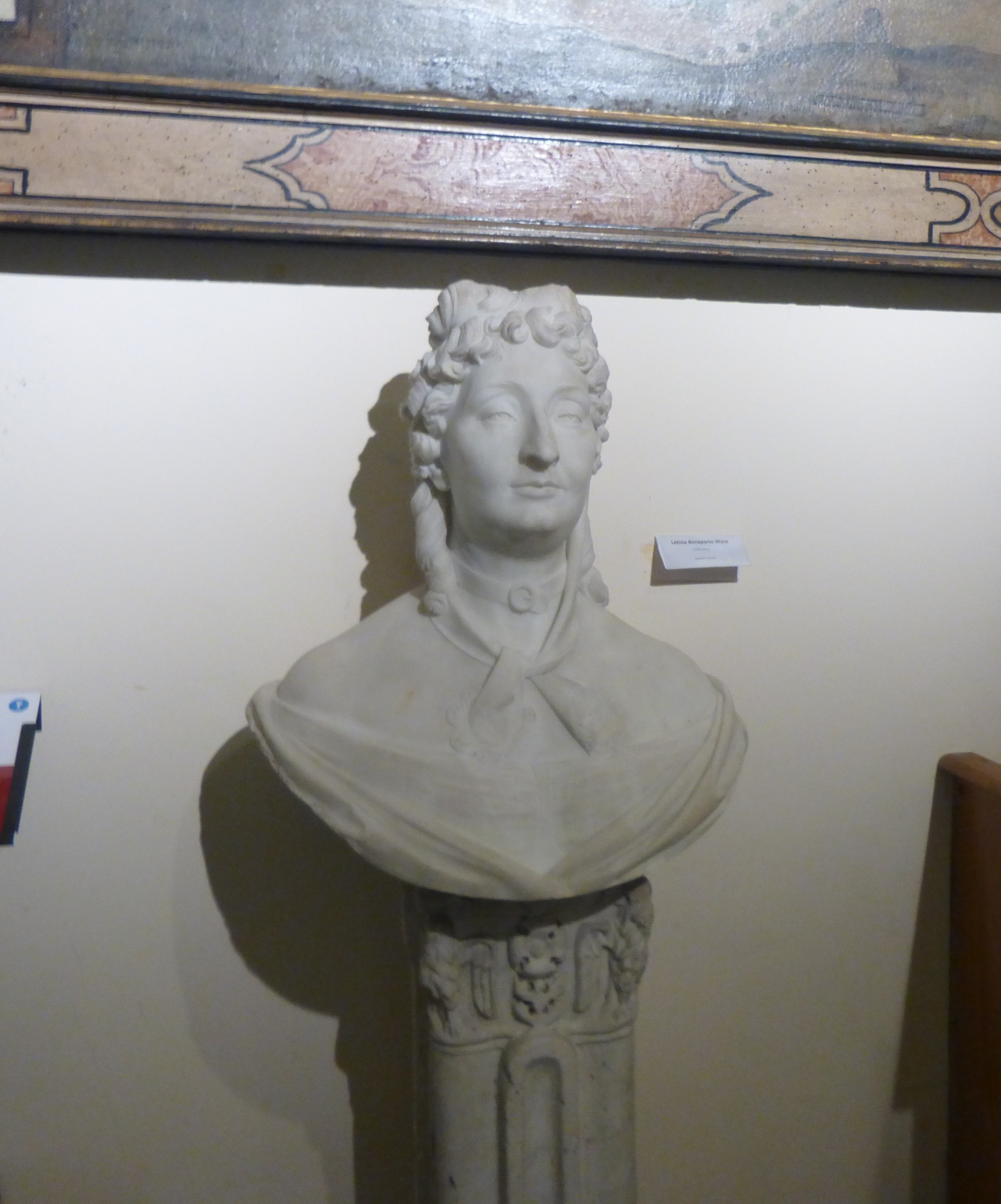
a bust of Letizia Bonaparte greets visitors to the Museum..
Among past visitors were Nathaniel Hawthorne and his wife Sophia  who passed through Viterbo in 1858. Both of them disliked the town: the waiters at their hotel cheated them and  they avoided the unsavoury San Pellegrino medieval quarter  but  spoke well  of the sunny resting spot at  the Papal Palace where they  relaxed and sketched the  airy loggia and  fountain.  Discover more about early  visitors to the Viterbo area in  my books  which are available  directly from the website or in bookshops in Italy. Some are also available through amazon.com
More about visiting the Papal Palace of Viterbo can be found on Archeoares website:  http://www.archeoares.it
..while Chiara and Barbara greet visitors at the adjacent bookshop

You are cordially invited to my next presentation, Friday  March  4th in Vetralla's Library .

Venerdì 4 marzo 2016 alle ore 16.30

PRESENTA 

      “I NOSTRI CASTELLI …                    ….VERI GIOIELLI”

di

    Mary Jane Cryan                


                       Storia, curiosità e turismo


More  info: Biblioteca Comunale di Vetralla – Via Brugiotti 41, 01019 Vetralla
Email: biblioteca@comune.vetralla.vt.gov.it        -     telefono  


Saturday, August 2, 2014

Living in a Renaissance Palazzo in Italy: Viterbo


Palazzo Chigi's tower
In central Italy  it is not  so unusual to live  surrounded by affreschi  of Renaissance masters.  The other day we were invited to visit  Serena Filoscia and her uncle Luciano who live in one of Viterbo’s most imposing buildings: Palazzo Chigi.
stairway to piano nobile

 Located in the very center of Viterbo, adjacent to City Hall
 (Palazzo dei Priori), over the ages the austere building has been home to numerous  powerful local families:  Caetani, Chigi , Montoro, Patrizi and  Crescenti.

For the past  few generations   the Egidi family  have called  it home and have done major  restorations, including that of the palazzo’s  tiny  private chapel.

loggia of Palazzo Chigi 

“The roof is so huge that it seems we are always repairing  it”, confided Serena as she greeted us at the front entrance doorway.   She and various other family members   live in apartments located  on the  main floor,  il piano nobile, where the ceilings  rise up  to an enormous height.  

Entering the  portone one catches a glimpse of  a beautiful fresco  by  Antonio del Massaro   (known as Pastura)  hidden behind a car and a dusty  Vespa.
Madonna attributed to Pastura 

 On the upper levels  frescoes greet  visitors at every turn: at the  top of the steep staircase, on the  loggia and throughout the reception rooms.

The windows  of the main salone  face an  imposing stone fireplace and give sunlight to the   numerous plants.  To one side, an  early piano-like instrument  ( un clavicembalo)   awaits  restoration.  

Renaissance  fireplace 
Uncle Luciano leads us into a smaller living room with  silk covered walls and family portraits. In one corner a 1980s  music center  and a piano  show that this was the room the family used for parties. 


A curtain is pulled up with a cord to reveal another room, the family chapel. Luciano shows us the chest of drawers in a niche that serves as sacristry.


 It must have been constructed on site, since it is  too large to have gone through the doorway.


sacristry of the  chapel 


The frescoes of Palazzo Chigi  have been the object of a university  thesis  and I understand why when we are shown a further, smaller  room completely  covered  with frescoes of gods, landscapes and hunting scenes  by Antonio Tempesta. 


At eye level there is a  parrot which gave  the room its name, Stanza del Pappagallo.


How does  this  Renaissance scenario and lifestyle  fit  in with today’s  world ?

 Just a short  walk from the historic  palazzo,  in Piazza S. Maria Nuova, you can visit the shop  GustoSi Senza Glutine where   Serena’s companion  has just opened  the area’s first laboratory  preparing  gluten free bread, pasta, pizza and sweets.  It is located  across  from the  outdoor  pulpit where St. Thomas Aquinas used to preach to the crowds in  the open air, many centuries ago. 

You will find many more stories of life in the Tuscia/Etruria  area in  my books which can be ordered directly from the website. 
Feel free to leave a comment  below and share with your friends  by clicking on the  icons.  
You can sign up to receive  new stories by leaving your email at the very bottom of this page.  


Sunday, March 16, 2014

Day Trips from Viterbo

Genius Loci of Villa Lante, Bagnaia
Living in the layer cake of history  that is  Italy, it is easy to visit  Roman, medieval  and  Renaissance sites  all in the same day.


a corner of  Bagnaia "di dentro" 


With the first real spring weather that is just
 what we did this weekend.  


ticket collector and cats 


While others biked or jogged in the  parks and  roads around  Viterbo, we took  half day trips to some of the area’s special  historical sites.
Chain fountain, Villa Lante

Marco  Zanardi at entrance to Villa Lante 
Saturday afternoon  was dedicated to Villa Lante in Bagnaia where guide Marco Zanardo  explained the Renaissance garden’s history and the philosophy of the cardinals Gambara and Montalto Peretti who created it in the 1500s.

medieval piazza, Bagnaia 
Sunday morning  was dedicated to  Ferento, the Roman city destroyed by the Viterbese  in the 11th century and now  a pastoral  area studded with remnants of  centuries of habitation.
horses graze at entrance to Ferento  
  
Vincenzo, our archeologist-guide 

 Ferento theatre's  black cat 


Roman building blocks 

mosaics, arches,  brick and mortar 
   I was happy to see that the SYA (School Year Abroad) students  are participating in  a study project at Ferento  along with archeologists of the Università della Tuscia.


Roman road brought back to light by SYA students
  Both these outings were marked by  sunny weather, interesting encounters, well versed guides   and a series of beautiful  cats who  accompanied the humans  who came to visit  their  territory.
Siamese of Bagnaia 


We were happy to meet professional photographer  Maurizio  Di Giovancarlo whose work  will entice you to visit the area.

  Your comments are welcome as well as suggestions for other special places to visit  near Rome, Civitavecchia  and  Viterbo.

For those  in Rome  on Tuesday March  25th, I hope to see  you at  the  presentation  of my latest book
ETRURIA STORIE E SEGRETI 
 to be held  at the prestigious library of 
Fondazione Besso, Largo di Torre Argentina,11
 on the first floor.
Time  5 p.m.  
Speakers :  Francesca Ceci, Cristina Carosi, Luca Pesante

Copies of the book are available in Rome at Libreria dei Viaggiatori, Via dei Pellegrino,78 near Campo dei Fiori  and at Anglo American Bookshop, Via della Vite near the Spanish Steps.