Showing posts with label sustainable tourism. Show all posts

Wednesday, September 20, 2017

Top Tourist Spots along the Adriatic


During  a  series of cruises along the  Adriatic  coast  I was struck by  the beauty and booming tourism in towns of  former  Yugoslavia,  previously part of the great Venetian marine empire in the 12-18th centuries. 

"living room" of Hvar-the main piazza 


just like Italy..... pizza break in lively Koper 
The  fortified ports of  Zadar, Koper, Dubrovnik, Kotor and  Hvar strung out along the  Adriatic  coast are now some of the hottest spots for  summer tourism.
 Each has its  unique  character, history and structure  but they also  share  lifestyles  and  traditions  similar to those found here, in  central Italy. For example,  the  use of the main piazza  as  the town’s  elegant living room for the  afternoon  passeggiata.  
artisans in Zadar  offer  their wares  on the street
costumed locals  in Koper/Capodistria
       

By studying  what our neighbors on the Adriatic are doing -and have done-  in the tourism field, we can  discover which mistakes to avoid  and which of their best practices to  follow. Here are some personal  observations and ideas  to help  increase tourism  while protecting   the  quality of life for  residents and visitors.  

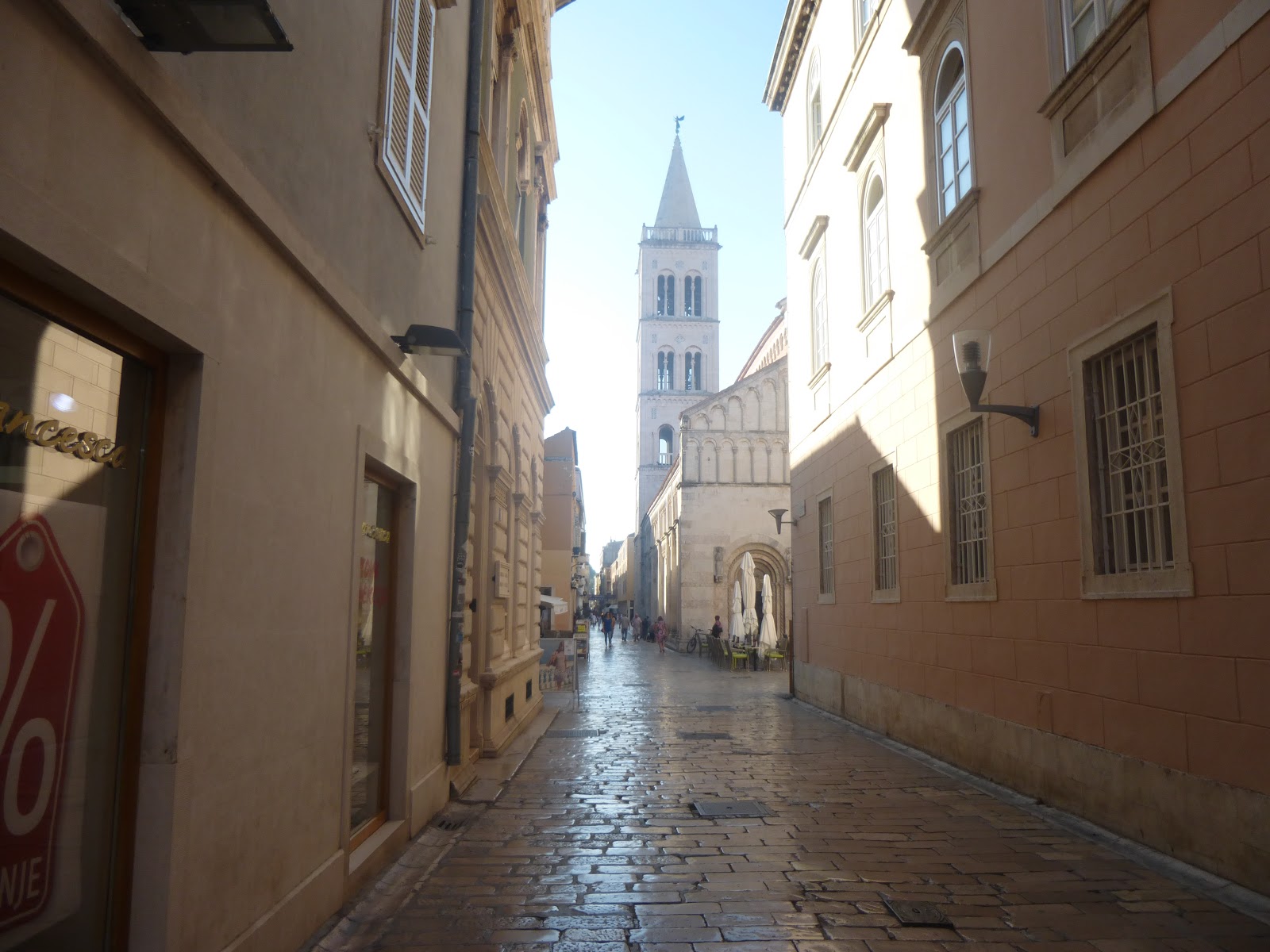
shiny stone pavements of Zadar
I noticed  that public spaces in all these lively port towns  were decorated with  street furniture and  flowers and,  most importantly, there were  no graffiti   nor  rubbish  to  be seen.  This  pride in their  spotless  main piazzas  and  streets- such as  Dubrovnik’s  Stradun- is expected also from  visitors. 

The tourism industry  must  protect this quality of life which is  one of the area’s main attractions, a quality that  the Tuscia Viterbese  has  in common with these colorful  Adriatic ports.
Too much popularity and tourist hoards  can be a strain on ancient historic centers.  Hvar town, a very popular party destination for young British tourists, has had to impose  rules of conduct  and stiff  fines (up to 700 euro)  to control  unruly behavior .
enjoy your stay and obey the rules

On the positive side, thanks to the silent electric  vehicles used   for  rubbish pick up and  deliveries in the pedestrian zones  the only noise is  the hum of  human voices and  instrumental music being played  at  many a street corner. The piazzas of Dubrovnik ,  Koper  and Zadar  resound with classical music played by  street performers  and buskers  often dressed in local costume.  


musician  and salt shop, Koper
Whether  it is  a violinist, a   guitar trio  or  Mozart being  played on musical glasses, a crowd  of people and  a pleasant mood are  always created.
The  huge crowds of rock concerts  are relegated to stadiums outside the delicate historic  centers where amplifiers  would be  a danger and  unnecessary. 
 In the port of Zadar even the sea has been harnessed to make music with the  recently created  sea organ which  plays tunes using the  lapping  waves of the sea .
sea organ, Zadar port 


 This human scale   combined  with beautiful architecture  gives a  sense of peace and  wellbeing that immediately strikes visitors coming from  foreign cities.  This  slower pace and  quality of life  are valuable  elements which no longer exist in giant cities and  suburban sprawl but are still fortunately  alive and well in most  towns of central Italy. 


 What answers  can you give to these  questions about your  town?
Is the main public piazza and/or main street  still an  elegant  public space used for  socialization  or is it   clogged with cars, speeding motorini  or  used primarily for parking?
Are the ancient, medieval and   Renaissance architectural gems  of the  historic   center given pride of place? 
tower in Zadar similar to those of Viterbo 
Are there green areas  and  parks  close to the historic center which are well cared for and used by the residents and visitors?   
SYA  students relax in Valle Faul, Viterbo 


Instead of the  Venetian lion seen  in all the Adriatic  ports, the  area of Tuscia boasts  other symbols on  palaces and castles:  Viterbo’s   lion and palm, the   heraldic  crests  that remind us of past Papal domination  and the local noble families -Farnese, Odescalchi, Monaldeschi -who once ruled the area.  
The construction materials   also differ: our local buildings are constructed of  grey  tufa and peperino  and we walk on cobblestone streets  instead of shiny  Istrian stone. 
Although less spectacular  than the majestic  city walls  surrounding  Dubrovnik and Kotor  those  of Viterbo, Tarquinia  and other local fortified  towns  have  yet to be given the attention they deserve .  

Wednesday, July 1, 2015

Italy's Summer Festival Delimma

 Pisa San Ranieri festival  illumination draws  crowds  
 If you are planning a summer stay in one of Italy’s beautiful mid-size towns be sure to  check the dates of the local summer festival before booking your flight and accommodations.   Many historic Italian towns celebrate summer with  festivals that  draw large crowds such as  Pisa’s  Luminara di San Ranieri and Gioco del Ponte which have been celebrated  in mid June for hundreds of years.
the tower of Pisa  by night 

Other towns like  Montefiascone and Vignanello have  invented festivals or sagre  celebrating  local wine  and local food stars at the Cene in Cantina in my hometown, Vetralla. 

Along with providing entertainment,  these festivals produce  a great  amount of  confusion  annihilating the usual lifestyle of historic towns.   
The  younger crowd  looking for  lots of action may enjoy  the added buzz of  a  summer festival, but if  you prefer more traditional, slower paced living and genuine Italian lifestyle, organize your holiday  stay  before or after the festival or book a place distant  from the festival venue in order to enjoy the festivities and also get a good night’s sleep.

Italian towns cannot  compete with the night life of  Ibiza or Mykonos yet  Vetralla’s  Cene in Cantina festival boasted  4 nights of  rock music  blasted by  powerful speakers  and a strange, sweet "perfume" wafted through the air  from 11 p.m. until well after 2 a.m. 
In Viterbo  the pseudo-cultural Caffeina Festival’s  ten evenings of happenings boasted many food stands cooking up fried foods and selling  alcoholic drinks in medieval piazzas where local restaurants regularly  close down.
circus or cultural festival? 
contrasting  with the medieval architecture 
 As tourists walked  through Europe’s best preserved medieval quarter San Pellegrino, they wondered:  What do energy drinks  and mojito have to do with medieval Italy?

The lower prices and commercial (junk) food served  at the 10-day festival  creates a lot of competition with  permanent restaurants offering quality local fare.. and what about the health safeguards?  During a  street-side show  cooking, a chef was coughing directly  onto the  food  being prepared.  

This year the organizers of the Viterbo festival, perhaps sensing their future demise, decided to milk the city’s major volunteer and cultural associations.

Archeotuscia presents in Cortile dell'Abate 

on the far right, Caffeina staff take "donations" 


 Archeotuscia with its 500+ members was given time and space on the festival  calendar to publicize  their association, but in order to enter  the piazza where the presentation was being held  everyone, including members, was  asked to “donate”  3.50 euro to Caffeina’s organizers. 

A mammoth book stall set up in the  main piazza seemed to be a sign of culture: but after scouring the tables loaded with books  and interviewing a volunteer (one of  250 who receive only a free meal and T shirt) I realized there was a complete  absence of books, authors and publications from and about  the Viterbo/Tuscia area 

book tent at Caffeina
There are a smattering of local authors presenting their latest books during the quiet dinner hours, and hopefully the audience will not mind paying a ticket to attend.
 It was a surprise  to see  an entire stand dedicated to Gabriele D’Annunzio’s  Vittoriale located on Lake Garda in northern Italy. This was done to  thank  a commercial writer  whose books have been presented numerous times at the Festival. 

The city's older residents,  families  and sleep deprived working people become prisoners of these summer festivals for they have little access to their neighborhoods and can be seen schlepping  their groceries from distant parking areas.

Local tourism operators, restaurants,  B&Bs and  artisans who keep the  historic center (especially San Pellegrino ) alive all through the year are not happy with the filth, broken bottles, hooligans and extra garbage produced.
San Pellegrino,  8:30 a.m. 

 Inhabitants and administrators are beginning to realize that concentrating large doses of festival/culture/action may not be worth the problems created.  This year the discussions concerning  these noisy  summer festivals  have been rife  and  the idea of  sustainable tourism is now  being considered.


historic fountain and portapotty
A set of guidelines and  rules of behavior are needed to protect the  rights of citizens living in the areas where the festivals are held.  Safeguarding  fragile medieval and Renaissance buildings, fountains and  piazzas  is another priority.
historic fountains masqueraded as plant holders

massive speakers for a tiny piazza 
 The architectural  monuments that make our towns and cities so special should not be masked by garish  carnival rides and  plastic flowers.  

A summer festival that involves high decibel  music should  have a proper  container: a stadium, a large outdoor space or  theatre  not  a tiny, flower filled piazza which serves as an outdoor living room to its inhabitants.
 Read  more about this on my previous blog  article.  
Your comments and shares are appreciated. What are summer festivals like in your area? 

Sunday, September 22, 2013

Boosting Tourism in Viterbo

E. Frangipane, A. Delli Iaconi, G.Curti, A.R. De Alexandris at new BIC center 

This  week  saw two important events  in Viterbo  for boosting  tourism: a visit of an  international meeting,  Certess,  organized  by the Lazio Region and the 16th international workshop BUY Lazio. The first  took place in the new  building of BIC Lazio, once  the  city's slaughter house. 
Recycling  an old building to new use


CERTESS  workshop with G.Curti & Bruno Blanco  

international  delegates 


translating  for  BIC workshop 
I  was happy  to be involved   as translator, meeting people from Palma di  Majorca, Finland, Croatia, Poland and several other European countries. 


 pilgrim guide to  Papal Palace 
The  visit  included  a workshop, discussion  and exploration of Viterbo’s   medieval quarter accompanied  by  an authentically dressed medieval pilgrim   (Massimiliano Vinci)  who led the group along  the old pilgrims’ route, Via di S. Clemente,  to the Duomo  and Papal Palace.


The guests were surprised  to see how coins were   minted at the  workshop of Maestro  Marco Guglielmi who also dressed the part.  This eclectic  artisan  works in  ceramics as well as coinage and has published several books.

Master  coin maker 
Throughout the  weekend  Viterbo was  bustling  with over  200 delegates at  the 16th edition of Buy Lazio,where buyers and sellers meet to  exchange information and  offers for  touristic services. The workshop is held in the ancient papal palace whose  soaring arches and tufa stone halls  recall the papal court which met here in the 13th century.

Buy Lazio stands 
Snappily dressed young  men and  girls (with dangerously high heels considering the cobblestones and steep stairs) were busy  promoting the folklore, traditions, gastronomy archeology, environment  and special itineraries  that exist for tourists  in the  five  provinces  of the Lazio region:  Latina, Roma, Rieti, Frosinone and  Viterbo.
red carpet  at the Papal Palace 

Buyers converged on Viterbo from  24 different countries  as far away as Mexico, Norway and Russia with a large percentage from central and eastern European countries (Slovenia,Ukraine,Slovakia Luthuania,  Hungary, Austria,Poland) and  Scandinavia (Norway, Finland,Denmark,  Estonia Sweden).
 As I write, on Sunday morning, the foreign participants are being treated to a post-workshop tour of Tuscania, Bolsena and Tarquinia before heading back to their respective countires.

Things  have changed  in these past  16 years: instead  of  reams of papers and  heavy  catalogues  appointments are now set up electronically so that face to face meetings and exchange of business cards are all that is  needed  to make contacts  leading  to a future  of sustainable tourism  for the  Viterbo area and all of Lazio. 


Sunday, July 22, 2012

The 1512 Vetralla Monument


On Saturday, July  21st  while showing a visitor from Scotland our town’s claim to English protection, I realized the  monument  was celebrating its 500th anniversary-and no one in town was interested…except us.
500 years of  English protection  


detail of  Henry VIII's coat of arms 

 Five centuries may seem like a long time, but  not in the layer cake of  European history  and not in an area where Etruscan tombs and sanctuaries dating from 800-300 BC dot the landscape.   

detail of Cardinal Bainbridge's coat of arms 
The year  1512 was a very busy one. Among the happenings in Europe:   
- the battle of Ravenna on   April 11th
- Pope  Julius II  opened  the Lateran Council in May
- Michelangelo’s  Sistine Chapel paintings were  publically shown for the first time in November
Holbein's portrait of Henry VIII 
- a baby named Anne Boleyn was born
-Niccolò Macchiavelli was expelled  from Florence by the Medici, newly returned  to power.
- Martin Luther was named  Doctor of Theology in Wittenberg.

In the new world the Spanish began importing black slaves to Hispaniola to replace the  local Indians  who were perishing at an alarming rate while along the coast of Newfoundland, European fishermen began exploiting the banks of cod fish, sending  the dried cod  back to Europe.

English ambassador visits Vetralla
 On July  20th, 1512 Pope Julius II donated the Castle of  Vetralla, an  important post  between Rome, the papal port of Civitavecchia and the city of Viterbo,  to the English crown. 
Cardinal  Christopher Bainbridge, Henry VIII's ambassador to Rome during those years and the only English prelate at the opening of the 5th Lateran Council, accepted  for his king. 


funerary monument of Cardinal Bainbridge, Venerable English College,Rome 
  In Vetralla, a sculpted marble monument and a smaller plaque with the date were set above the main portal of  the castle, thus sealing the alliance between  young Henry VIII and the Papacy in  the Cambrian League  against the French.
axes and squirrels feature on Bainbridge  coat of arms

 For the first time, Henry laid claim to some  French land, thus the title  King of  France  (REX FR) was included in the  inscription  of the Vetralla monument. 
Over the centuries  the heraldic  plaque was moved several times  and since the 1700s it has graced the  main staircase of the governor’s palace, now the City Hall.  
A few years ago volunteers cleaned the monument revealing the full beauty of its  heraldic motifs. Several coins  from the early  19th century were found lodged  among the intricate carvings.

Andrea Natali  cleaning the  1512 English monument 
 Unfortunately no documents  concerning the monument have yet come to light and most of the local population continue to ignore its significance and its very existence.

 This post is part of my submission for Team Florens, a meeting to be held in  autumn  where themes such as boosting economy through cultural awareness will be debated. 

Hopefully local cultural identity can grow and use existing historical monuments, especially those with international connections like the Vetralla 1512 monument, to create opportunities for tourism  in  towns not on regular tourist circuits.  Learn more about Fondazione Florens here.     

Latest  visitors   to Vetralla from England were a group  of young university students who had cycled all the  way  from Manchester, through  Holland, France and northern Italy. They were amazed  at the English connections  we pointed out to them.

posing  beneath the English monument  and
the bust of Cardinal Henry Stuart, Duke of
York, protector of  Vetralla