Showing posts with label Farnese. Show all posts

Sunday, March 24, 2013

Bomarzo's Sacro Bosco

Have you visited  the town of Bomarzo...or only the Park? 


     For centuries  scholars have tried to understand  the meaning behind the esoteric sculptures of the  16th century park  created by Vicino Orsini  in the valley below his palazzo in the tiny town of Bomarzo.  Perhaps  the  secret code of the Sacro Bosco  has finally been broken.

Orsini's Sacro Bosco, also known as the Park of Monsters,   has a new interpretation thanks to  Antonio Rocca whose study  Bomarzo Ermetica  was presented on Saturday in the magnificent  salone of Palazzo Orsini castle of Bomarzo.


above our heads -frescoed ceilings 
surprised  to see the floor tiles are just like mine 
 Among those present, local politicians, foreign professors and a large number of young people interested in the history and art of the area.

left to right: Mayor Roberto Furano, Sofia Varoli Piazza, Irene Temperini 
During the conference  landscape architect and historian  Sofia Varoli Piazza  explained  the connection  between landscape and historic gardens in the Tuscia area, others expounded on the  economic value of beauty and  how to promote  and protect sites such as the Sacro Bosco.

symbols or Vicino Orsini on the palazzo facade 


Off limits areas of  the palazzo-now the City Hall- were opened  allowing us to view the private  terrace with mottos by Orsini.  
Here  are a few of the inscriptions telling Orsini's  philosophy.


SPERNE TERRENA POST MORTEM VERA VOLUPTAS 

SAPIENS DOMINABITUR ASTRIS 


FATO PRUDENTIA MINOR 


Symbols of the Orsini and Farnese families-the bear, the rose and the lily-can be seen throughout the palazzo and the town. 
Orsini bear and Farnese  lily  by Claudio Magagnini
The park  was created  by Vicino Orsini  to honor his wife Giulia Farnese, to express his philosophy and  to amaze and out-do  his  contemporaries who created their Renaissance gardens  in other towns of the Tuscia-Viterbo area also  known as Etruria. 
the Sacro Bosco  lies in the valley below the palazzo
At the palazzo complexes  of  his contemporaries (Marescotti Ruspoli in Vignanello,  Lante della Rovere in Bagnaia and Farnese in Caprarola) the gardens are all adjacent to the buildings,  but at   Bomarzo  the park  is quite a distance away since the palazzo is built atop the steep hill. 

    The two sites complement one another: without the palazzo, the park, now owned by the Bettini family,  is incomplete and vice versa.

from this terrace, Vicino Orsini looked down to  his  Sacro Bosco
Over the centuries  the  roads that linked the Sacro Bosco to the palazzo on the hill  have been destroyed but hopefully they can be newly joined. If the administration can solve the parking problem with a shuttle bus many of the thousands of  tourists who come the park each year could also enjoy  the rarely seen historic center and the palazzo. 

 As usually happens in Italy, the conference ended with a buffet. It was  served  in the entrance hall of the palazzo,  overflowing into the piazza . 


The author and friends improvise  a table in the piazza
After  the buffet  and some exploring in the old medieval center, Antonio Rocca  accompanied  those present  to the Sacro Bosco for an  in depth, on site explanation.    Have you been to the town of Bomarzo?  to the Sacro Bosco?    
Your comments, questions, reactions  are welcome.  You can leave comments (lasciare commenti, anche in italiano  qui sotto) Then  click anonymous in the window that opens...or with your name and/or website. 


Sunday, September 18, 2011

Borgia,

Castles  and Capers   in Borgia  Country

Loggia  and fountain  of Palazzo Farnese, Caprarola

Borgia, Farnese, Orsini… these  are just  a few of the powerful  families  who  held sway in  Etruria , an area north of Rome   that  the Italians  call Tuscia Viterbese . 

Borgia-Farnese  castle, Nepi 
Thanks  to  their   connections,  powerful   papal nephews  were able  to acquire  lands and create  magnificent  palazzi  and  gardens  in this now quiet area north of Rome. 


Nepotism allowed them to commission  splendid  estates and art work for  their private enjoyment and to dazzle  visitors. 

As  modern  TV series show,  many of the papal  family members   were not  always   up to religious  standards. 
Their lifestyles were often  more  outlandish and   exciting  than anything  a script  writer  could invent today.     

waterfall  near Borgia Castle  at Nepi 
Farnese  coat of arms, Nepi 

 Nepi - Borgia fortress

Lucrezia  Borgia,  daughter of Pope Alexander  VI, Rodrigo Borgia,  was often visitor  in Nepi where the  towers, massive walls and  underground areas still  ooze  history even when a modern day gastronomy festival is  happening.


One of the papal nephews  of  the Farnese  family  was  responsible  for  the magnificent  Palazzo Farnese, in Caprarola. Along  with the Palazzo Farnese in Rome –the present  French Embassy –  it epitomizes    Renaissance  architecture and art.

upper gardens  of  Palazzo Farnese, Caprarola


upper gardens and Casina dei Piaceri


  Caprarola’s Palazzo Farnese,  designed  by Architect   Vignola, can be considered  the original  pentagon  for  it has  5 sides,   a circular  central courtyard  and  perfectly  square or rectangular  rooms.       And what rooms!


design  by Justin Bradshaw  
There are  frescoed  walls including  the  map room dedicated  to explorers. The  gilded ceilings  and multi-colored terracotta tile floors are  perfectly  maintained mosaics . The south-facing  rooms were used in winter,while  those on the northern side, were lived in  during the hot summers.
glazed terracotta  tiles of the loggia, Caprarola


 This hillside  town  named after  goats (capra=goat)   is  a perfect   place to   relax  in style, just as it was for  powerful men  of the past, from the   Farnese  popes and  cardinals to  Prince Charles  and  Italian presidents  in pre-Berlusconi  days.


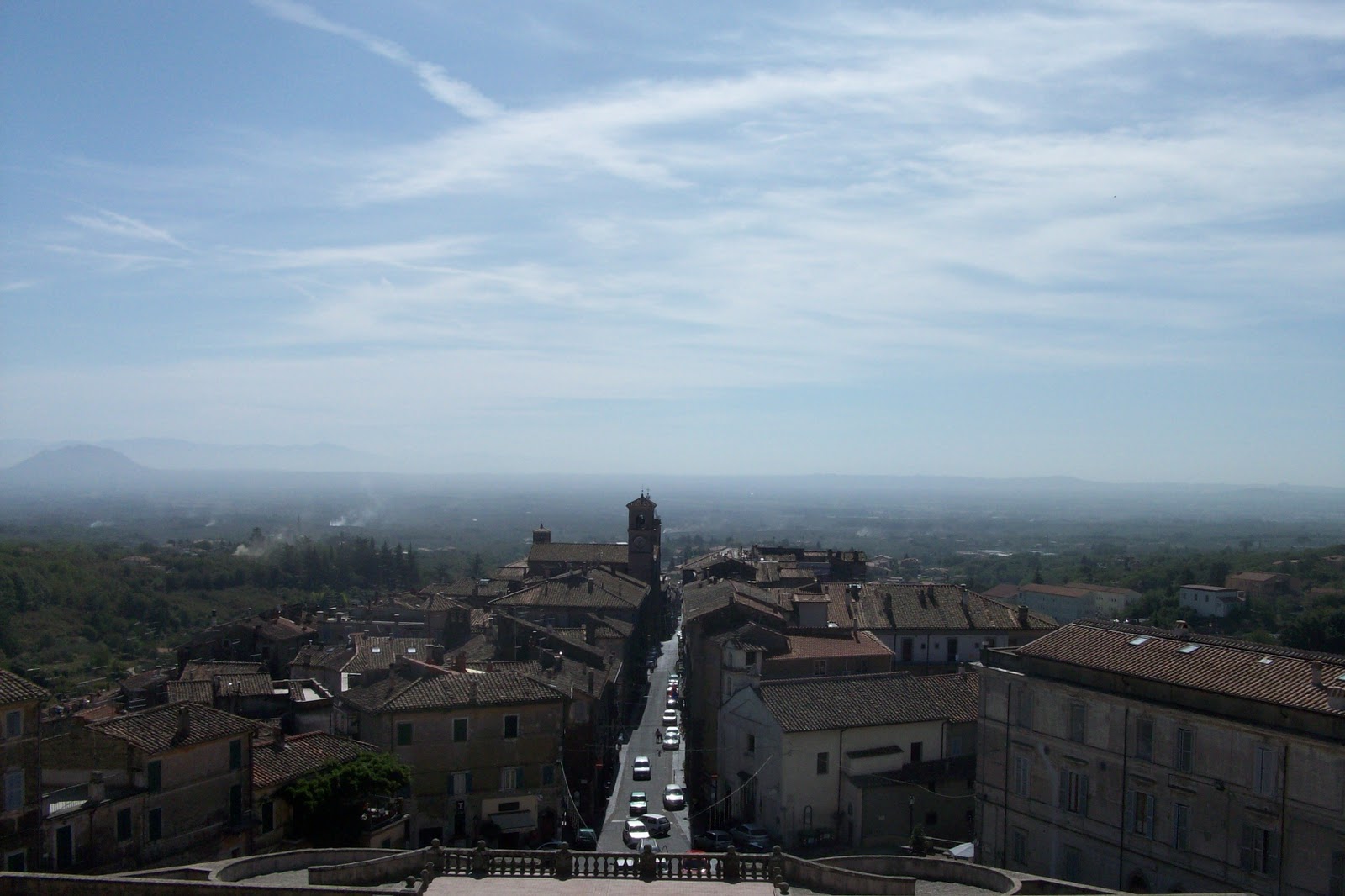
view towards Rome from Palazzo Farnese, Caprarola

The views from the loggia of Palazzo Farnese stretch  all the way to Rome (35 kms )  while   Mount Soratte’s  majestic   outline  looms  in the distance. 


fresco  by Zuccari , Palazzo Farnese, Caprarola

The Zuccari  brothers and their crew of  decorators  did not  have to worry about  expenses   thus  the Palazzo , its  gardens , fountains  and the   Casina  dei Piaceri  show   papal nepotism  on a grand scale .   

Along the lakeside road  traveled by  artists, architects and stone masons  who   worked  with the wealthy families  of  Viterbo,  Vetralla  and  Caprarola  we find a simple  fountain  of Santa Lucia, emblazoned with Farnese  symbols.   
Santa Lucia, Lake DiVico , between Vetralla and Caprarola


Capers,  considered  an aphrodisiac, still  grow  today  on  the south facing  walls   and were    used  for  medicinal purposes, to help digestion and hangovers. 

Opening the hydraulic system for   giochi d'acqua
Interestingly ,   the word caper,   also means a  joyful leap  or  a  high- spirited escapade . Note  the  water games installed  to surprise  visitors with sprinkler systems that are still perfectly  functional today.

Another  “season  of capers”   happened  in the early 1900s when an   eccentric   Boston lady  and her daughters   lived at the Palazzo and their lifestyle  was immortalized  in   Gabriele D’Annunzio’s   “Le Vergini delle Rocce”.  
For more about  the palace and the underground multimedia  area  check  out Palazzo Farnese .

For more stories about  the palazzi and gardens of the area  purchase your signed  copy of "Etruria-travel, history and itineraries in central Italy".